How to Rank in Google AI Overviews as a Small Business?

David BarbourFounder
In this article
Google AI Overview Results For Businesses
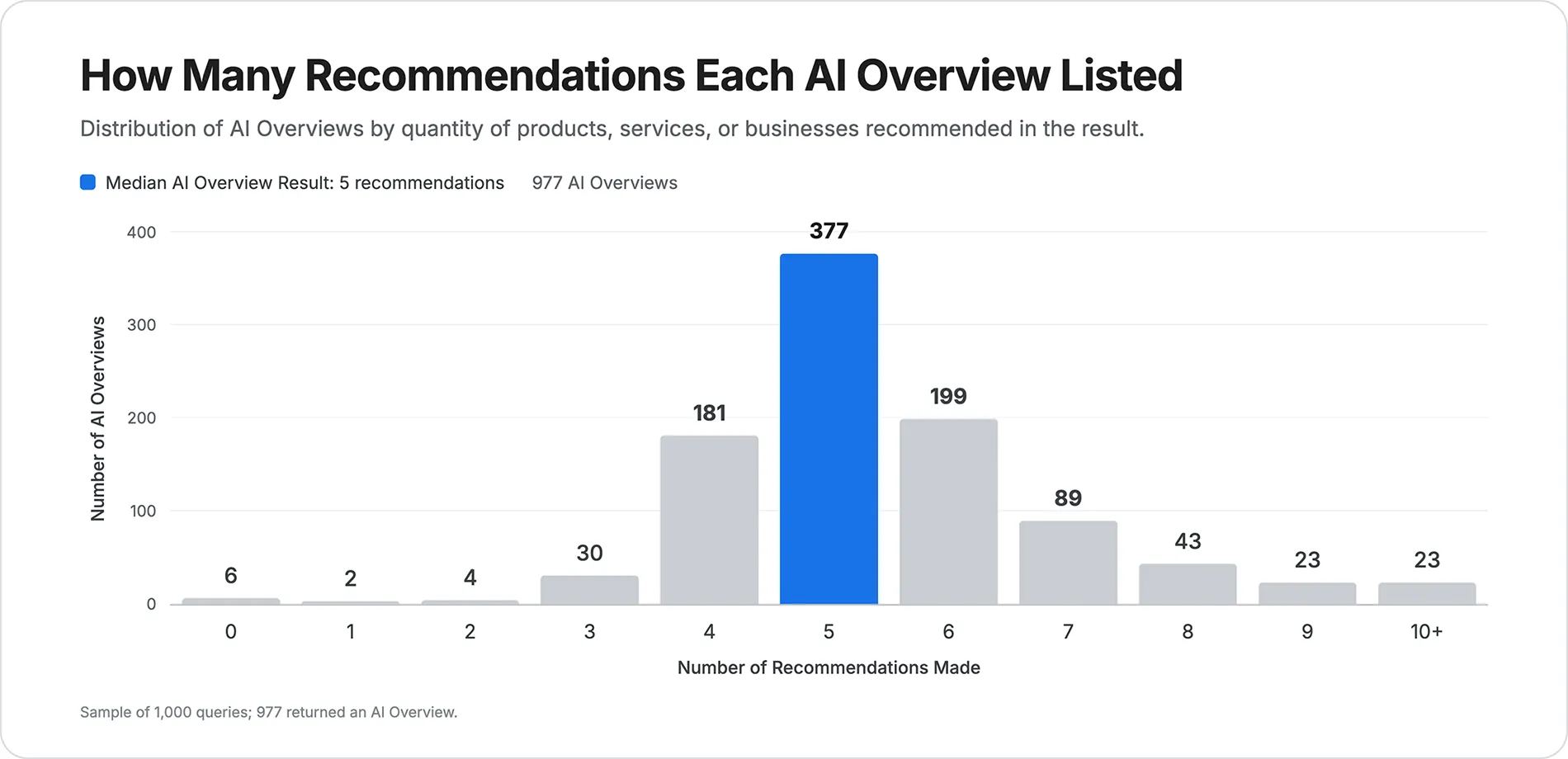
At Spotlight AI, we conducted a study of Google AI Overview results. Focusing on Google searches relevant to businesses across a range of factors; product, services, business recommendations, national searches, statewide searches, or city searches. These searches are representative of what small and mid-size businesses are competing for, which shows the importance of AI overview.

Business research · 1,000 searches
Spotlight AI tested 1,000 Google searches people commonly use to research products, find services, and choose businesses. The results show how often AI Overviews appear in these customer-focused searches.
AI Overview appearance rate by search type
AI Overview appearance rate by location phrasing
400 searches tested
300 searches tested
300 searches tested
440 searches tested
90 searches tested
470 searches tested
National searches named no location. State searches sampled all 50 U.S. states, and city searches sampled 100 U.S. cities. Location refers to the words in the search query, not the searcher’s physical location. Product searches were tested nationally only.
Google Search is changing rapidly for businesses that rely on it to attract customers. AI Overviews appear far more frequently in searches for products, services, and businesses than in general searches, making AI Overview optimization increasingly important. According to Similarweb’s 2026 Generative AI Landscape Report, AI Overviews appeared in approximately 43% of U.S. Google searches in May 2026. In contrast, Spotlight AI found AI Overviews in 97.7% of 1,000 searches focused on researching products, finding services, and choosing businesses. While the studies use different search samples, the contrast highlights how prevalent AI Overviews can be when potential customers are researching their options.
Read the full research report: How Google AI Overviews Affect Searches for Products, Services & Businesses.
AI Overviews Are Changing Search Behavior
Google AI Overviews and AI Mode are changing how people search, and for small businesses, this creates a major opportunity. In competitive markets, the first few organic search positions have historically been dominated by established companies that can be extremely difficult to outrank.
But Google now generates answers directly within its search results, combining information from multiple sources to respond to increasingly specific customer questions. This creates new opportunities for smaller businesses to be discovered, cited, and recommended without necessarily ranking at the top of traditional organic search results.
Consider a pest control company in Los Angeles. It probably already has pages covering rat removal, pest control services, and the locations it serves. But what happens when someone searches, “Which pest control companies in Los Angeles have experience handling rat infestations in condominium buildings?”
That’s a highly specific question from a potentially valuable customer. A generic rat removal page might not provide enough information to establish whether a company has experience with multi-unit buildings, shared entry points, coordinated treatments, or condominium pest control projects.
This is where having more comprehensive content becomes a competitive advantage. A company with detailed pages connecting its services to specific situations gives Google more relevant information to use when constructing its answer.
And that’s just one example. Customers ask thousands of variations of questions about services, pricing, locations, qualifications, and specific problems. Platforms like Spotlight AI help businesses build an expanding library of content that connects what they offer to more of these searches automatically.
The opportunity isn’t just to rank for a handful of keywords anymore. It’s to become a relevant source for the many different answers Google generates for your potential customers.
AI Overviews and AI Mode: From Search Results to Conversations
Google Search is no longer just a list of results. A customer can start with a general search, receive an AI Overview at the top of the page, and ask follow-up questions directly from that answer, transitioning into AI Mode without ever needing to scroll through the traditional organic search results.
This makes Google Search increasingly conversational. Someone might start by searching “Best pest control companies in Los Angeles” and receive an AI-generated answer with several recommended businesses. From there, they could ask:
- “Which of these companies handles large condominium buildings?”
- “What methods do they use to prevent rats from returning?”
- “Which companies have experience working with HOAs?”
- “How much would a project like this typically cost?”
Each follow-up gives Google more context about what the customer actually needs. AI Mode conducts additional web searches, retrieves relevant information, and refines its answers as the conversation progresses.
This exchange creates opportunities for businesses that weren’t necessarily mentioned in the original AI Overview. A company might be overlooked in the first response but become a highly relevant recommendation once the customer asks about a specialized service, application, or specific requirement. Businesses that invest in comprehensive content have more opportunities to earn mentions and recommendations, both in the initial AI Overview and in subsequent AI Mode responses as the customer narrows their search.
How Query Fan-Out Creates More Opportunities
Both AI Overviews and AI Mode can use a technique called query fan-out, where Google breaks a question into multiple related searches to gather the information needed for a complete answer.
Even a relatively general search can lead Google to investigate several surrounding topics, often more specific than the original query. As the customer asks more detailed follow-up questions, that research can become increasingly focused.
Each of these related searches can surface different webpages and sources of information. A page that might not appear for the customer’s original search could be highly relevant to one of the more specific questions Google investigates. This expands the opportunities for businesses to have their content discovered and included in the AI-generated answer.
This is why publishing content that covers your business from many different angles is so important. A business with pages addressing specific services, pricing, qualifications, applications, customer situations, and real-world scenarios has more opportunities to provide information across those related searches, including questions from highly qualified potential customers.
Ideally, you want your business to appear in the very first AI Overview. But if it doesn’t, the opportunity isn’t necessarily lost. As customers refine their questions, businesses with content that directly addresses those increasingly specific needs have additional chances to be discovered and recommended.
Every follow-up question creates another opportunity for your business to become part of the answer, making comprehensive content an increasingly valuable investment in Google Search.
Content and Signals That Earn Visibility in Google AI Overviews
Getting included in Google AI Overviews starts with the same foundation as traditional SEO: useful, relevant, trustworthy content that Google can discover and index. But AI-generated answers create additional opportunities because Google can combine information from many sources to address different aspects of a customer’s question.
Rather than simply presenting a ranked list of webpages, Google can conduct multiple related searches, retrieve supporting information, and generate an answer directly within its search results. This changes how businesses compete for visibility. Your content doesn’t necessarily have to be one of the top organic results for the original search to provide valuable information that Google uses in its AI-generated answer.
The goal is to make your content a valuable source of information for the answers Google is constructing, while clearly connecting that information to your business.
Here are the most important content elements to focus on:
- Direct Answers and Clear Page Structure: Answer the main question early, use descriptive headings, and organize information into understandable paragraphs, lists, and tables. Make it easy for Google to locate specific facts and explanations.
- Detailed Coverage of Customer Questions: Go beyond general service and product descriptions. Address pricing, applications, materials, qualifications, comparisons, customer problems, and specific situations where your business can provide a solution.
- Original Information and Firsthand Experience: Include actual project examples, photographs, measurements, case studies, pricing information, and observations from your professional experience. Information that demonstrates what your business knows and has accomplished provides more value than generic explanations available on hundreds of websites.
- Expertise and Supporting Evidence: Clearly identify relevant credentials, qualifications, and sources of information. Reference authoritative research where appropriate and support important claims with evidence. Google emphasizes experience, expertise, authoritativeness, and trustworthiness (E-E-A-T) in its guidance for evaluating content quality.
- Relevant Images and Videos: Use original photographs, demonstrations, diagrams, and videos that help explain the subject. Google AI results can incorporate visual information, making useful multimedia another opportunity to establish relevance.
- Clear Connections to Your Business: Explain how the subject relates to the products, services, locations, and capabilities your company actually offers. Don’t leave Google to make these connections on its own. Content that explicitly connects your business to the questions potential customers ask gives Google more relevant information to use when evaluating recommendations.
For example, consider an electrical contractor in San Diego that specializes in residential EV charger installations. Someone searches Google for “Can I install a Level 2 EV charger if my home only has a 100-amp electrical panel?” A contractor with a detailed article covering electrical requirements, panel upgrades, installation costs, and real project examples could provide valuable information for that AI Overview. If the article also highlights the company’s experience installing EV chargers in older San Diego homes, it establishes a direct connection to customers searching for that specific expertise.
Now expand that content with dedicated pages about charger compatibility, electrical panel upgrades, installation in detached garages, and other common customer questions. Together, these pages create a network of relevant information that gives Google more opportunities to discover, cite, and recommend the business across different searches, including related questions explored through query fan-out.
The more specific, useful, and original information your business publishes, the more opportunities Google has to discover your content when generating AI Overviews and AI Mode responses. Especially for specific searches which often represent high-value searches where a user is close to the end of their research and is likely to convert - you want to be there when they do.
Business Signals That Strengthen Your Likelihood to be Recommended in Google AI Overviews
Content is only one part of the equation. Google also needs to understand who your business is, where it operates, what it offers, and whether the available information about it is reliable.
For small businesses, there are several additional steps worth taking to strengthen this foundation.
Google Business Profile and Customer Reviews
For local businesses, your Google Business Profile is one of the most important sources of information you can maintain, especially when Google presents local business listings and recommendations in its AI-generated results.
Make sure your business categories, service areas, phone number, website, operating hours, and other details are accurate and complete. Add relevant photographs and encourage genuine customer reviews.
Google explicitly identifies review volume and positive ratings as factors that can help local search rankings. While reviews don’t guarantee inclusion in an AI Overview, they provide additional information about your business’s reputation and customer experiences.
Customer reviews can also connect your business to specific services and real-world situations. For example, a review describing an electrician’s successful EV charger installation in an older home provides more context than a generic five-star rating.
But you shouldn’t rely on customers to make these connections for you. Publishing your own detailed content about the services, scenarios, and customer needs you address gives Google more direct information to work with, while reviews can provide independent supporting evidence.
Structured Data and Schema Markup
Schema markup helps search engines understand the entities and information represented on your website. Implemented through JSON-LD, it can explicitly identify your business and describe its attributes.
Different businesses should use the schema types relevant to their operations:
- LocalBusiness: Identify your business name, location, phone number, website, operating hours, and other relevant local details. More specific business types can be used where appropriate.
- Organization: Establish your company’s identity, website, logo, contact details, and connections to official profiles through properties like sameAs.
- Service and OfferCatalog: Describe the services your company provides, the areas they serve, and how those offerings relate to your business. These Schema.org types can clarify relationships, although Google does not provide a special AI Overview enhancement for them.
- Product and Offer: For ecommerce businesses, identify products, specifications, prices, availability, and other purchasing information. Proper product markup can support Google’s product-related search features.
- BreadcrumbList: Help Google understand the organization of your website and the relationship between individual pages and broader categories.
For example, an electrical contractor could use LocalBusiness markup to establish its identity, location, and contact information, while service-related structured data describes its EV charger installations, electrical panel upgrades, and residential electrical services.
The value is in making the relationships between your business, services, products, and factual details more explicit. Schema markup isn’t a guaranteed AI Overview ranking factor, but properly implemented structured data gives search engines additional context about your business and content.
Additional Credibility and Business Information
Beyond your own website, Google can encounter information about your company through other sources.
- Industry Directories: Maintain accurate profiles on relevant platforms, such as Avvo for attorneys, Angi for home services, or industry-specific professional directories.
- Independent Reviews: Build genuine customer feedback on relevant review platforms and maintain a consistent business identity across listings.
- Professional Credentials: Make licenses, certifications, affiliations, awards, and other verifiable qualifications publicly available where relevant.
- Google Merchant Center: Ecommerce companies should maintain complete product feeds with accurate pricing, availability, descriptions, and product identifiers.
- Consistent Business Information: Make sure your name, contact details, business locations, and services are accurate across your website, Google Business Profile, and other important platforms.
These efforts work alongside your content strategy. Detailed pages establish how your business is relevant to specific customer questions, while accurate listings, structured information, reviews, and independent sources help establish its identity and credibility.
Together, they give Google more information to discover, understand, and evaluate your business when constructing AI-generated answers and recommendations.
The Different Types of Google AI Overview Results
Google AI Overviews take different forms depending on the search. They can answer questions, compare products, recommend businesses, or display local listings with maps, ratings, and pricing. Each format creates different opportunities for small businesses to earn visibility.
| AI Overview Type | When It Appears | Opportunity for Businesses |
|---|---|---|
| Direct Answers and Informational Summaries | Questions about costs, procedures, definitions, or how something works. | Earn citations by publishing accurate explanations, guides, and answers to customer questions. |
| Comparisons and Recommendations | Searches comparing products, services, features, pricing, or the best options for a particular need. | Get products or businesses mentioned by publishing detailed specifications, comparisons, pricing, and use cases. |
| Local Business Recommendations | Searches for businesses or service providers in a particular city or nearby area. | Earn recommendations through relevant local content, complete business information, and credible reviews. |
| Map-Based Local Results | Location-focused searches where proximity, service areas, and business locations influence the answer. | Appear alongside map information and business recommendations by strengthening local SEO and Google Business Profile signals. |
| Product and Transactional Results | Searches involving products, shopping decisions, hotel comparisons, prices, or availability. | Provide accurate product or service details, pricing, availability, and structured information that supports purchasing decisions. |
These formats can overlap. An AI Overview might recommend businesses, compare their services, display a map, and cite supporting websites within the same answer.
The important takeaway is that your business can earn visibility in several ways: as a cited information source, a recommended provider, a local business listing, or a product being compared. Understanding which formats appear for your industry’s most valuable searches helps you focus your content and optimization efforts.
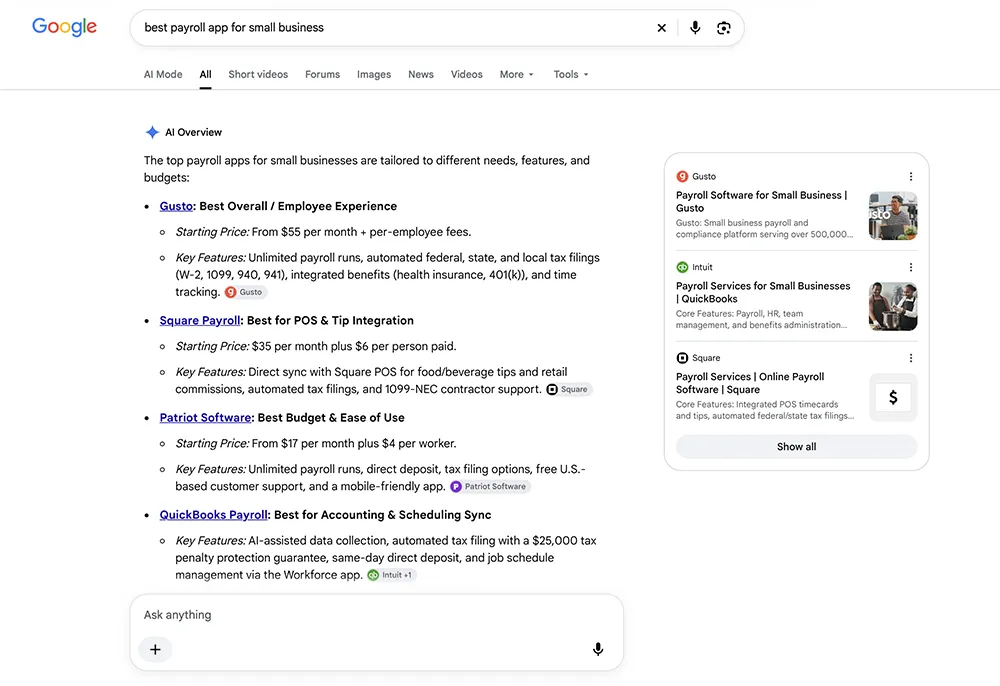
Comparisons and Recommendations
In this example Google AI Overview compares payroll providers by pricing, features, and business needs. Google identifies relevant comparison criteria and recommends businesses based on how well their offerings match those requirements.
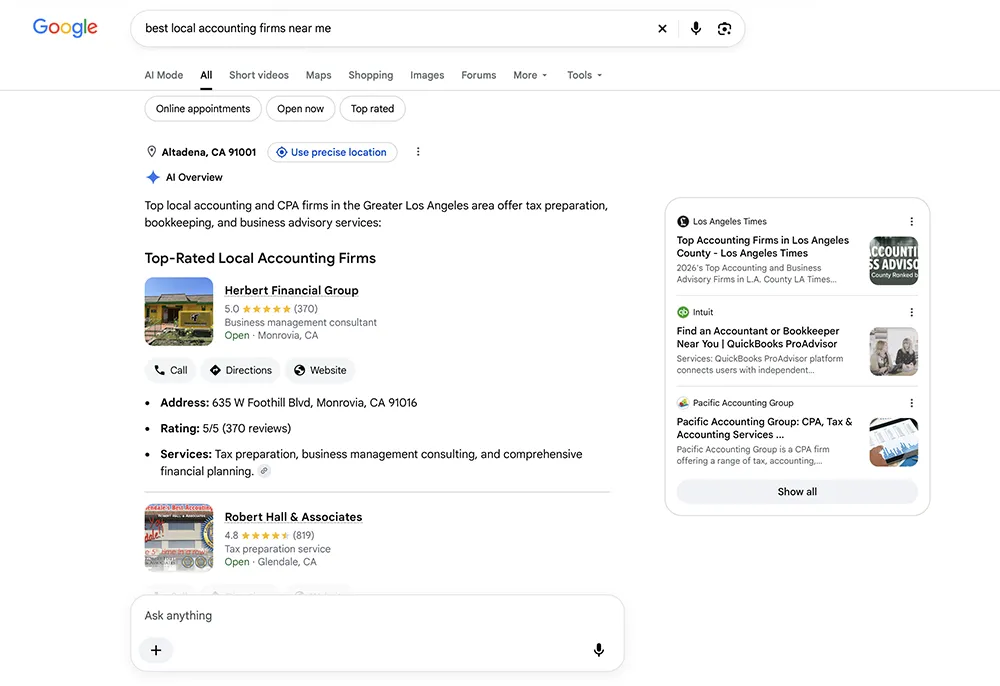
Local Business Recommendations
In this example Google AI Overview recommends accounting firms with ratings, services, and contact options. This highlights the importance of a complete Google Business Profile, customer reviews, and detailed information about your services.
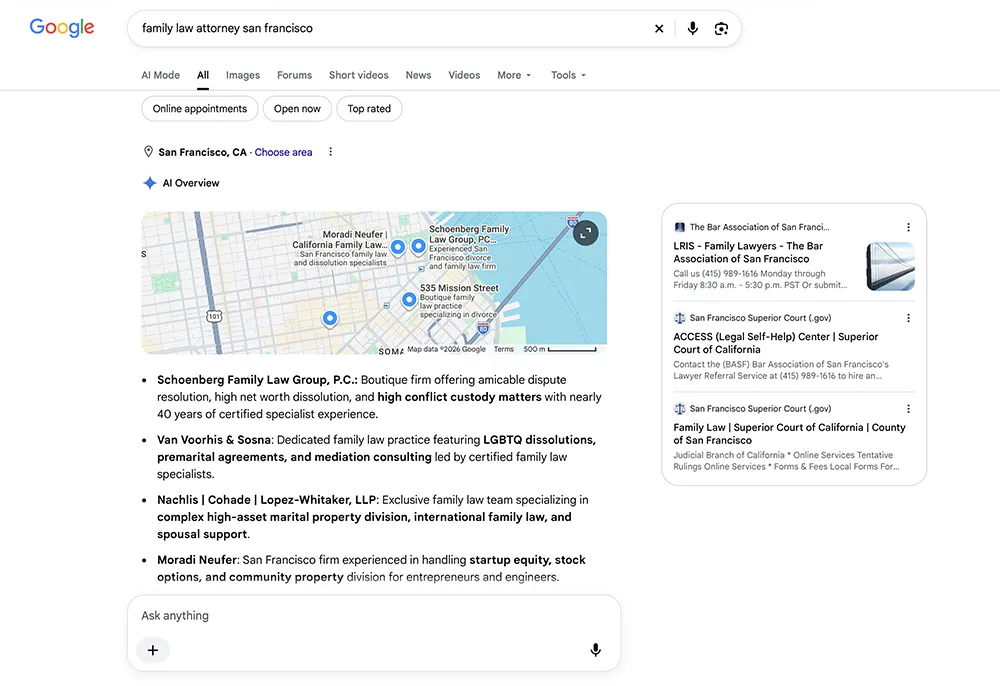
Map-Based Local Results
In this example Google AI Overview combines a map with local attorneys and descriptions of their specialties. This demonstrates the value of connecting your services and expertise to specific locations through website content and accurate Google Maps listings.
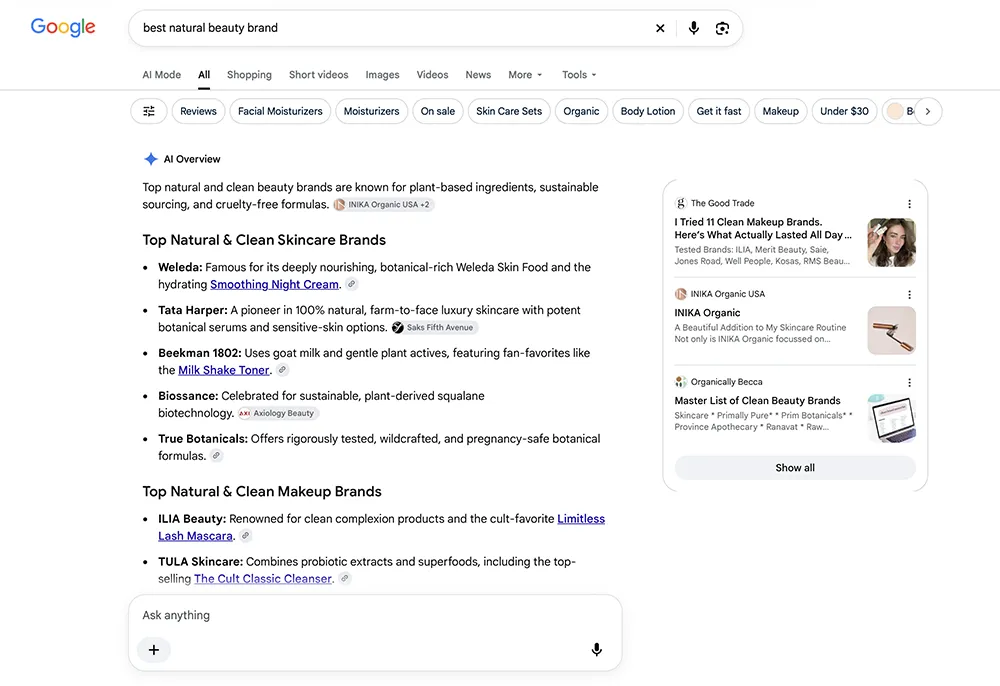
Product and Brand Recommendations
In this example Google AI Overview recommends natural beauty brands based on ingredients, product benefits, and specialties. It also links directly to products and cites sources, highlighting the importance of detailed product content, clear brand positioning, and third-party credibility.
Make Your Website Accessible to Google AI
Before your content can appear in Google AI Overviews, Google needs to be able to access, crawl, and index it. Google AI Overviews rely on the same technical SEO foundations as traditional Google Search, so there is no separate AI indexing process or special markup required. If Google crawler can’t find you then Google AI models using live web won’t be able to find you either.
Make sure your website has these technical foundations in place:
- Googlebot Accessibility: Allow Googlebot to crawl your website through robots.txt and your hosting infrastructure. Make sure your CDN, firewall, and bot protection settings aren’t indiscriminately blocking legitimate search engine crawlers.
- Indexing and Crawlability: Maintain XML sitemaps, internal links, canonical URLs, and proper indexing settings so Google can discover your pages.
- Readable Page Content: Use accessible HTML with clear headings, paragraphs, lists, and tables. Make sure important information is available to Google, including content rendered through JavaScript.
- Page Performance: Keep pages fast, mobile-friendly, and easy to navigate.
- Google Search Console: Use URL Inspection to confirm Google can access and index your pages, and monitor indexing errors or crawl issues.
Google documentation confirms that pages must be indexed and eligible to appear in Search with a snippet to qualify as supporting links in AI Overviews. Even excellent content won’t earn citations if Google cannot access it.
Content Freshness and Why Continuous Publishing Matters
Publishing high-quality content is important, but maintaining it is just as valuable. Google AI Overviews continually construct answers using information retrieved from Google’s search index. As new information becomes available, older content can lose relevance, particularly when newer sources provide more complete or accurate answers.
Content has a practical shelf life in AI search. Pricing changes, products evolve, customer questions shift, and competitors publish new information. Pages that aren’t maintained risk becoming less useful compared with newer or more complete sources.
The strongest approach is to continuously expand your content coverage while keeping existing information accurate, relevant, and up to date.
How Spotlight AI Keeps Your Content Active and Relevant
This is exactly what Spotlight AI is built to handle. The platform automatically researches, writes, and publishes new content daily to your business’s dedicated knowledge base, continually expanding the questions, topics, and customer needs your business is connected to.
Spotlight AI also regularly updates existing pages to keep their information accurate, relevant, and fresh. This gives Google AI Overviews and other AI systems current, reliable information to consider when selecting sources to cite and recommend.
Rather than publishing content once and hoping it continues performing indefinitely, Spotlight AI keeps building and maintaining your business’s presence in AI search. And it handles the ongoing work without adding another responsibility to your marketing team.
Frequently Asked Questions About Ranking in Google AI Overviews
Do I Need to Rank Number One in Google Search to Appear in AI Overviews?
No. Google AI Overviews don't simply summarize the highest-ranking organic results. Google's AI models use information retrieved through its search systems, including related searches through query fan-out, to construct an answer from multiple sources. This means your website can be cited or your business recommended even if you aren't among the top organic results for the original search.
Should I Continue Investing in Traditional SEO?
Yes. Traditional SEO remains essential because AI Overviews rely on Google's existing search infrastructure and Gemini AI models. Continue improving your rankings, technical SEO, website authority, and content while expanding coverage of the specific questions customers ask.
Do Google Reviews and Google Business Profile Help With AI Overview Rankings?
They can support your local visibility. Google Business Profile provides business details, locations, ratings, and reviews that may appear alongside AI-generated recommendations. Google confirms that positive ratings and review volume can help local search rankings, although neither guarantees inclusion in an AI Overview. This is especially important for local businesses to rank in AI Overviews.
Do I Need Special Schema Markup or an llms.txt File for Google AI Overviews?
No. Google doesn't require special AI schema or llms.txt files. Traditional structured data, including LocalBusiness, Organization, and Product schema, can help Google understand your business and support established search features. It is a nice to have.