How to Rank in ChatGPT for Small Businesses?

David BarbourFounder
In this article
ChatGPT, like other AI models, works differently from traditional Google search. Its responses are dynamic and context-driven rather than fixed rankings. Your business might appear in one user’s answer, while another person asking the exact same question sees different businesses mentioned or recommended. Which is exactly why right now is such an important time for small businesses to invest in answer engine optimization (AEO). AI search is evolving rapidly, and the ultimate winners are far from being decided.
ChatGPT has over 1.2 billion weekly users, according to OpenAI. It’s become synonymous with using an AI chatbot. And for businesses, the commercial opportunity is massive. In September 2026, visitors referred by AI converted 90% better than non-AI traffic on U.S. retail websites, according to Adobe Digital Insights. As more customers turn to AI to research products, compare services, and decide which businesses to trust, getting your brand into those answers is becoming increasingly valuable.
So, the question is, how do I get ChatGPT to mention, recommend, or cite my business? The answer is content.
Content has always been central to traditional SEO. But with ChatGPT, it plays an even bigger role. Your content isn’t just competing for a position in search results. It’s helping shape the answers AI gives its users.
ChatGPT is built to turn information into answers. It learns patterns and relationships from vast amounts of information during training and can retrieve additional content through live web searches. That makes publishing relevant, accurate, and trustworthy information about your business incredibly valuable. The more quality content connecting your products, services, and expertise to the questions customers ask, the more opportunities ChatGPT has to find, understand, and include your business in its answers.
Make Your Content Accessible and Understandable to ChatGPT
Your content should make it easy for ChatGPT to find useful answers, extract relevant information, and understand how your business, products, and services relate to the questions customers are asking. That means publishing enough high-quality content to cover the questions your customers ask, while regularly adding new pages and updating existing ones to keep the information current and directly relevant to the answers ChatGPT is constructing.
There are several technical foundations to get right, both for the website hosting your content and the individual pages you publish:
- AI Crawler Accessibility: Make sure OpenAI’s OAI-SearchBot can crawl your website. Check that robots.txt, firewalls, and bot protections allow access so ChatGPT can discover and reference your content when answering questions and recommending businesses.
- Schema Markup (JSON-LD): Use structured data to clearly identify your business, products, services, locations, and page content.
- AI-Friendly HTML Structure: Use descriptive headings, clear paragraphs, lists, tables, and easily readable page content so AI can identify and extract useful information.
- Markdown and AI-Readable Files: Consider Markdown versions of pages and an llms.txt file to make information easier for compatible AI tools to consume. These are optional enhancements, not requirements for ChatGPT visibility.
- Crawlability and Indexing: Maintain XML sitemaps, internal links, canonical URLs, and proper indexing settings so search engines can discover your content.
- Agentic Browsing Readiness: Use Google Lighthouse’s experimental Agentic Browsing audits to evaluate how effectively AI agents can navigate and interact with your website.
Spotlight AI builds and hosts your business’s knowledge base with these technical foundations already in place. Every page is created with AI-friendly structure, schema markup, crawlability, fast performance, and the latest practices for ChatGPT Search and agentic browsing.
Spotlight AI handles all of this automatically, from website infrastructure to daily content publishing and ongoing updates. Every page is designed from the ground up to give ChatGPT and AI agents the clearest, most accessible information possible about your business, products, and services in relation to the types of searches and prompts that would be relevant to you and your potential customers.
Structure Your Content for ChatGPT Answers
Connect Your Business to More Customer Questions
Each page should address a specific customer question or subject in depth, provide clear and trustworthy information, and establish how your business, products, or services relate to that information.
Why does this matter? When someone asks ChatGPT for a recommendation, the answer often depends on specific requirements. Location, price, intended use, product features, service capabilities, qualifications, and other factors all influence which businesses or products are relevant to that person’s needs.
Your content should cover these decision-making factors wherever relevant, making it easy for ChatGPT to understand exactly when and why your business is a good match.
For example:
Service business: Someone asks ChatGPT, “Who builds pools in Phoenix?” But the conversation doesn’t end there. They might follow up with “How much does a backyard pool cost?” “What pool designs work best for smaller yards?” or “Which pool materials last longest in Arizona?” A pool construction company with content covering actual price ranges, pool dimensions, design options, materials, construction timelines, and completed local projects gives ChatGPT specific information to answer each question. By covering these details, the company increases its chances of being recommended throughout the conversation as the customer narrows their options and gets closer to hiring a contractor.
Product business: Someone asks ChatGPT, “What’s a good air purifier for a small bedroom?” A manufacturer with content covering room size, filtration performance, noise levels, pricing, and product comparisons gives ChatGPT information to evaluate against the customer’s requirements. But the opportunity goes further. By connecting those specifications to real-world situations like small bedrooms, quiet sleeping environments, and specific room sizes, the manufacturer can create content that directly answers many different customer questions and connects its products to each of them, rather than letting ChatGPT have to make those connections alone.
The more thoroughly your content addresses these factors, the more opportunities your business has to be included in relevant ChatGPT answers.
This is why investing in content that covers everything your business offers, from the many angles customers might search for, is so important. Many businesses still rely on pages written for traditional Google search, leaving ChatGPT to piece together what they offer, who they serve, and why they’re relevant.
ChatGPT can’t confidently recommend your business for something it can’t find clear evidence you offer.
Structure Your Pages for Easy Extraction and Citation
Once you’ve identified the questions and buying decisions your content needs to address, the next step is organizing that information so ChatGPT can easily find, understand, and reference it.
Here are the most important page content elements to get right:
- Direct and Conversational Page Titles: Write titles that clearly describe the question being answered or the information provided. For example, “How Much Does Commercial Roof Replacement Cost in Phoenix?” is more specific than “Commercial Roofing Services.” Focus on how real customers phrase their questions to ChatGPT.
- Answer-First Introductions: Provide a clear, direct answer to the main question within the opening paragraph. Give ChatGPT useful information immediately, rather than making it search through several paragraphs of introductions or promotional text.
- Key Takeaways and Table of Contents: Summarize the most important facts near the beginning of the page. For longer articles, include a linked table of contents so readers can navigate directly to the information they need.
- Author, Expertise, and Publication Dates: Identify who created the content, their relevant expertise, and when the information was published or last meaningfully updated. Support important factual claims with credible sources.
- Descriptive H2 and H3 Sections: Organize the page around specific questions, related topics, and customer needs. Each section should provide a useful explanation that makes sense even when read independently from the rest of the article.
- Structured Answers and Supporting Evidence: Use comparison tables, FAQs, lists, original statistics, examples, and factual explanations where appropriate. Make important information easy to locate, verify, and reference.
- Clear Business and Brand Connections: Naturally connect the subject to your business, products, services, expertise, and service areas. Explain exactly what your business offers and how it relates to the questions being answered, giving ChatGPT the information needed to consider your business when making relevant recommendations without being overly promotional.
- Internal Linking and Content Freshness: Link to related articles, service pages, product information, and other useful resources. Regularly review and update existing content to maintain accuracy and cover new developments.
The goal is to make every page a valuable source of information that ChatGPT can understand and reference, while clearly establishing why your business is relevant to the questions customers are asking.
Spotlight AI puts these content practices to work automatically for your business. Every day, it researches, writes, and publishes new pages with direct answers, conversational titles, structured information, and clear connections between your business and the questions potential customers ask ChatGPT. Each page is designed to make your products, services, and expertise as relevant and easy to reference as possible.
As your knowledge base grows, Spotlight AI covers more customer questions, comparisons, use cases, and service areas while continuously improving existing content. The result is an expanding library of AI-optimized pages designed to increase your brand’s mentions, citations, and recommendations over time, without adding work to your team.
Learn more about how Spotlight AI helps small businesses grow through AI search.
How Query Fan-Out Works in ChatGPT Search
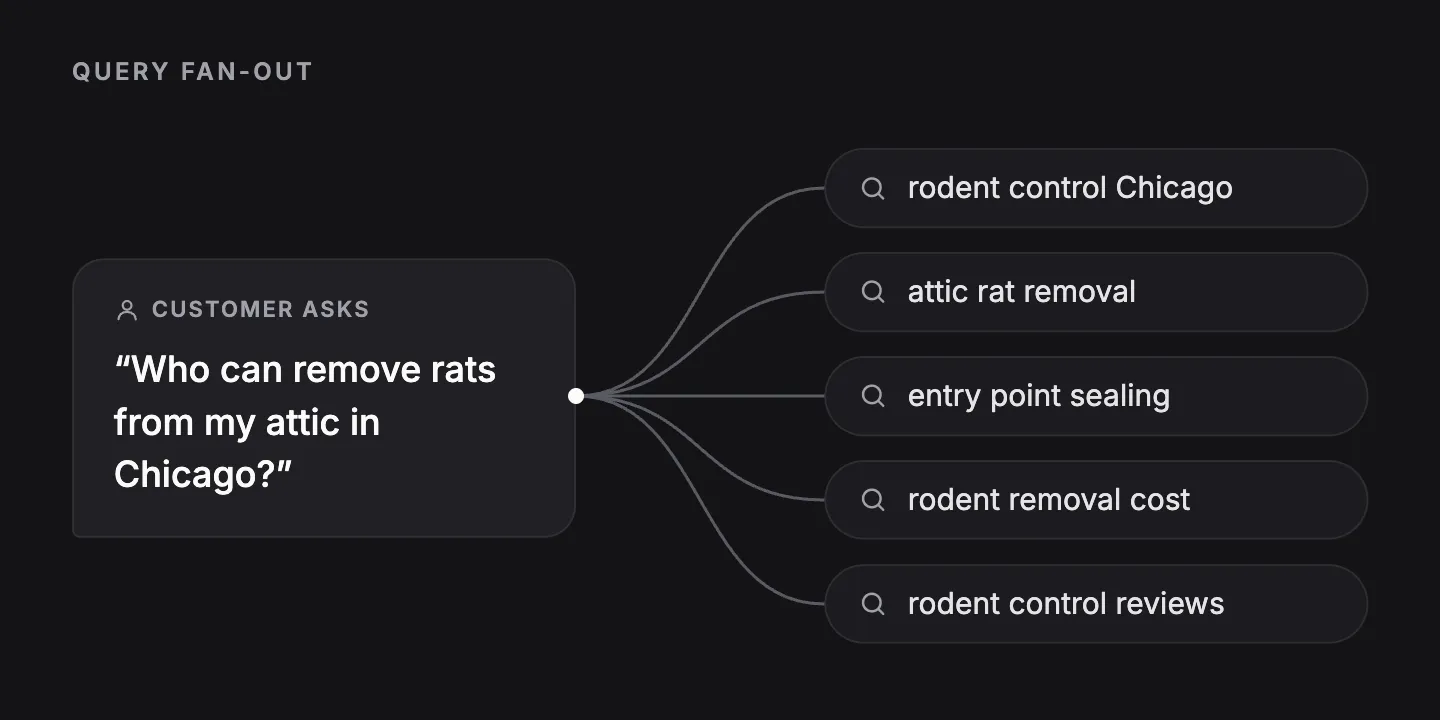
When someone asks ChatGPT a question, it doesn’t necessarily search the web for that exact question. Instead, ChatGPT can break the request into multiple related searches to gather the information needed to construct a complete answer. This process is commonly called query fan-out.
For example, someone asks ChatGPT, “Which rodent control companies in Chicago can remove rats from my attic and prevent them from coming back?”
ChatGPT might search for several related topics:
- Rodent control companies serving Chicago
- Attic rat removal and extermination services
- Rodent exclusion and entry point sealing methods
- Average rodent removal costs in Chicago
- Attic cleanup, sanitation, and damage repair
- Local rodent control company reviews and qualifications
Each search can bring back different sources of information. ChatGPT can then evaluate that information and combine relevant findings into an answer tailored to the customer’s original question and chat context.
This is why having content that covers your business from many different angles is so valuable. A rodent control company with pages covering its removal services, pricing, attic treatments, exclusion methods, sanitation services, and local experience has more opportunities to be discovered across those related searches. And because each question a customer asks could trigger its own query fan-out, having more relevant content to serve those additional searches compounds your opportunities to provide information that ChatGPT can use when evaluating and recommending businesses.
Rather than relying on a single page to answer every possible question, your business content becomes a collection of relevant information that ChatGPT can draw from when constructing answers.
The goal is to make your business relevant across the broader research process, not just the exact question the customer originally asked. This gives you more opportunities to be cited, mentioned, or recommended in ChatGPT’s answers.
Build Trust and Credibility Beyond Your Own Website
Your website tells ChatGPT what your business offers, but it isn’t the only source of information it may use when deciding which companies to mention or recommend. Customer reviews, business directories, social media discussions, industry publications, and independent recommendations can provide additional evidence of your business’s reputation, experience, and credibility.
For local businesses, maintaining an accurate Google Business Profile and earning genuine Google reviews are important starting points. Platforms like Yelp, the Better Business Bureau (BBB), Angi, and Expertise.com can also be valuable. Different industries have their own relevant sources. For example, attorneys can establish profiles on Avvo and FindLaw, while software companies may benefit from G2. Social media engagement and customer discussions can further expand your brand’s public presence.
One practical strategy is to ask ChatGPT the same questions your potential customers would ask and examine which third-party sources it cites. If certain directories, review platforms, or industry websites repeatedly appear, prioritize building and improving your business’s presence on those platforms.
Keep your listings accurate, encourage authentic customer reviews, publish evidence of your experience, and maintain consistent business information across the web. The goal is to give ChatGPT more credible, independent information to draw from when evaluating whether your business is worth recommending.
These trust and credibility signals can be especially valuable when customers ask ChatGPT to compare businesses or recommend the best providers. Combined with comparison guides and other relevant content that Spotlight AI creates for your business, these sources work together to support both discovery and validation. Your content helps ChatGPT understand why your business is relevant, while independent sources help establish why it is credible and worth recommending. Together, they can strengthen your visibility across a wider range of ChatGPT searches and recommendations.
Track Your ChatGPT Visibility and Improve Over Time
How do you know if your efforts to rank in ChatGPT are actually working? Unlike traditional Google search, ChatGPT doesn’t have a fixed set of rankings you can check. Its answers vary depending on the user’s question, conversation context, and information available when the answer is generated.
This makes tracking your visibility across relevant customer questions essential. You need to understand whether ChatGPT is mentioning, citing, and recommending your business, which competitors are appearing, and where opportunities exist to improve.
Spotlight AI makes this measurable by tracking the prompts most relevant to your business, products, services, and industry. Rather than overwhelming you with complicated SEO metrics, Spotlight AI focuses on the analytics that matter most: When potential customers ask AI about the products or services you provide, is your business in the answer? Yes or no?
By monitoring these prompts over time, Spotlight AI helps you understand where your business is visible, which competitors are being recommended, and which customer questions represent opportunities for new content. The Spotlight AI content engine then uses these insights to guide the creation of new pages and optimization of existing content, automatically turning visibility insights into action without requiring you to do the work yourself.
The goal isn’t just to publish more content for the sake of content. It’s to continuously improve how often your business appears in the answers that matter to your customers.
The Future of AI Search: From Chat to AI Agents
As AI becomes more powerful and integrated into everyday life, its role in how customers discover businesses, research products, and make purchasing decisions will continue to evolve. For businesses, this makes investing in AI visibility increasingly important.
AI Adoption Will Continue Changing How Customers Find Businesses
As ChatGPT becomes more capable and widely used, more customers are likely to rely on it to compare products, research service providers, and decide which businesses to trust. Online data already shows that traffic from AI sources is on average more engaged traffic.
Every customer who turns to ChatGPT instead of traditional search represents another opportunity for your business to be discovered and recommended. As AI adoption grows, so does the value of being included in the answers it provides.
ChatGPT Dots and AI Agents Will Research, Compare, and Buy for Customers
The next major shift is already beginning with ChatGPT Dots, OpenAI’s always-on personal AI agents that can research, use connected apps, and carry out tasks on behalf of users.
Imagine someone telling their dot, “Find a reputable rodent control company in Chicago, compare pricing and reviews, and schedule an inspection.”
Instead of manually researching companies, the customer could increasingly delegate that work to their AI agent, which could evaluate providers, narrow the options, and potentially complete a booking with appropriate permissions. If your business never makes it into the options that AI agent considers, you never even get the chance to convert that customer.
This changes AI from simply recommending businesses to potentially determining which businesses get considered in the first place. If reliable information about your services, pricing, qualifications, or reputation is missing, your business may never make the shortlist.
Today, AI visibility helps you get mentioned and recommended. Tomorrow, it could determine whether your business is considered when AI agents research, book, and purchase on behalf of their users.
The content and credibility you establish today can help position your business for both.
Frequently Asked Questions About Ranking in ChatGPT
Is My Existing SEO Work Still Relevant, or Should I Focus on ChatGPT Instead?
Yes, traditional SEO is still important, and you should continue investing in it. Many of the foundations of good SEO, including high-quality content, technical accessibility, website authority, and clear information about your business, also support visibility in AI search.
The difference is that traditional SEO primarily focuses on visibility in search results, while Answer Engine Optimization (AEO) focuses on making your business relevant to the answers AI generates. The strongest strategy is to maintain your SEO efforts while expanding your content and visibility specifically for AI search. Platforms like Spotlight AI make this possible without adding more work to your marketing team, allowing you to continue your existing strategies while getting ahead in AI search.
How Does Ranking in ChatGPT Differ From Google Gemini, Claude, and Perplexity?
Each AI platform has different models, search capabilities, information sources, and methods for constructing answers.
ChatGPT can draw on information learned during training and retrieve additional information through web searches. Google’s Gemini can use Google Search to ground its answers, while Perplexity is especially focused on retrieving and citing live web sources. Claude can also search the web when that capability is available.
These differences mean your business might be recommended by one AI platform but not another, even for the same question. Publishing accurate, comprehensive, and easily accessible content across your website and credible third-party sources gives you a stronger foundation for visibility across multiple AI platforms.
Can My Business Rank Number One in ChatGPT?
Not in the same way it can rank number one in traditional Google search results. ChatGPT generates dynamic answers based on the user’s question, conversation history, preferences, and available information. The businesses it recommends and their order can change from one conversation to another.
Instead of targeting a single number-one ranking, focus on increasing how frequently your business is mentioned, cited, and recommended across the customer questions most relevant to what you offer.
How Does ChatGPT Decide Which Businesses to Recommend?
ChatGPT considers the user’s specific request and the information available to it. Depending on the question and whether web search is used, relevant factors may include location, services, pricing, product specifications, qualifications, customer reviews, and information from independent sources.
For example, a customer looking for an affordable pool builder specializing in small backyards has different requirements from someone looking for a luxury custom pool. The more clearly your content connects your business to those specific needs, the easier it is for ChatGPT to recognize your relevance.
Can Small Businesses Compete With Larger Brands in ChatGPT?
Yes. ChatGPT recommendations depend on relevance to the customer’s request, not simply company size or brand recognition. Smaller businesses can have opportunities to appear when they provide specific services, serve particular locations, or offer expertise that closely matches what the customer needs.
A local contractor with detailed content about its services, pricing, completed projects, and service areas may provide useful information for a highly specific customer question.
For small businesses, the opportunity is to become the most relevant answer to the questions their ideal customers are asking. This could be the biggest new search opportunity for small businesses since the rise of the internet.
How Long Does It Take to Start Appearing in ChatGPT Answers?
There is no guaranteed timeline. Your visibility depends on factors such as how accessible your content is, whether ChatGPT retrieves it, the relevance and credibility of the information available about your business, and the questions customers ask.
Publishing new pages does not guarantee immediate discovery or recommendations. It takes ongoing content creation, improvements to existing pages, and consistent monitoring to understand what is working.
The important thing is to build a growing collection of accurate, useful content that gives ChatGPT more opportunities to discover and consider your business.
How Can I Tell If My Business Is Showing Up in ChatGPT?
You can start by asking ChatGPT the questions your potential customers would ask and reviewing whether your business appears in the responses. However, checking a few questions manually provides only a limited snapshot because ChatGPT’s answers can vary between conversations.
Spotlight AI automatically tracks the prompts most relevant to your business and measures whether your brand is being mentioned, cited, or recommended. You can see where your business appears, which competitors are receiving visibility, and where opportunities exist to improve.
Spotlight AI then uses these insights to guide its automated content creation and optimization, helping you continuously work toward appearing in more of the answers that matter to your business.